The Azores Location: Where Exactly Are the Azores Islands?
If you’re planning a trip and wondering, “Where exactly are the Azores?”, you’re not alone. It’s one of the most common questions people ask me when they first hear about these beautiful islands. Next to questions about the Azores location, the most common question is what are they! You can find out more about that all through this site
The Azores location is quite remote. They are an archipelago in the middle of the Atlantic Ocean. They belong to Portugal, but they are not located on mainland Europe. They sit roughly 1,500 km (930 miles) west of Lisbon and about 3,900 km (2,400 miles) east of North America.
On a world map, I always tell people to draw a line from New York City to Lisbon and you’ll see tiny specks of rock floating in a vast blue ocean. Those tiny specks hold some of the most dramatic scenery in Europe.
A Portuguese Archipelago in the Atlantic
The Azores are an archipelago; a chain of nine inhabited volcanic islands divided into three groups:
- Eastern Group: São Miguel and Santa Maria
- Central Group: Terceira, Graciosa, São Jorge, Pico, and Faial
- Western Group: Flores and Corvo
Although they feel far away, they are fully integrated with Portugal. The official language is Portuguese, the currency is the Euro, and the culture reflects centuries of Portuguese history, blended with a deep connection to the Atlantic.
For many visitors from Canada or the United States with Azorean heritage, this location is especially meaningful. The islands are geographically closer to Europe, but culturally they have strong ties to North America due to generations of emigration. In many ways, they feel like a bridge between continents.
Is the Azores Location in Europe or North America?
Geographically, the Azores sit on the Mid-Atlantic Ridge, a tectonic boundary between the North American and Eurasian plates. Parts of the islands rest on both plates which makes them geologically fascinating.
Politically and culturally, however, they are European. As an autonomous region of Portugal, the Azores are part of the European Union.
Travelers will find easy connections through Lisbon or Porto, modern infrastructure including good roads and health care, and European standards for food, safety, and accommodations. A lot has changed since my first visit in 1989. Despite being part of Portugal, there is a distinct culture in the islands.
If you’re traveling from Canada or the U.S., the flight time is often 5 to 7 hours from the East Coast, making it closer than many European destinations.
Why the Azores Location Feels So Remote
Even though the islands are well connected by air, their location in the middle of the Atlantic gives them a rare sense of isolation.
There are no neighboring countries. No mainland crowds spilling in for the weekend. The ocean is in every direction and the landscape is punctuated by volcanic features and mountains, as well as lush greenery everywhere. That’s part of the magic that I talk about.
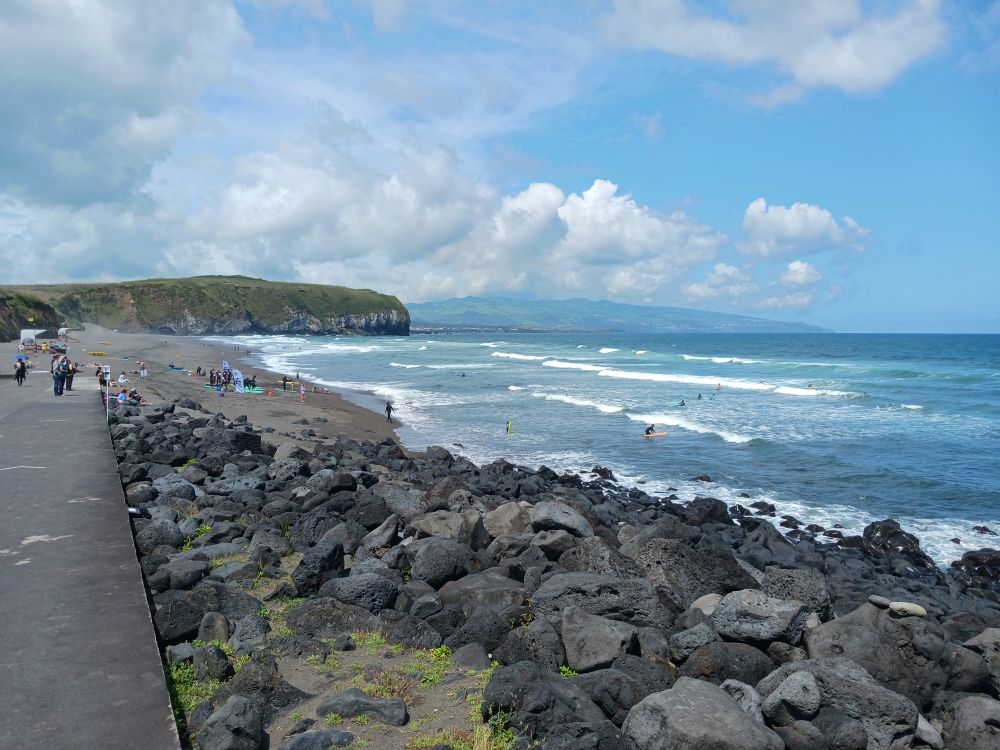
The Azores feel peaceful too. You can spend the morning hiking along volcanic crater lakes and the afternoon enjoying your beverage of choice in a seaside setting. You can find dramatic cliffs, green pastures, and black volcanic sand beaches, all shaped by their unique mid-ocean location.
For travelers looking to escape busy tourist centers, the Azores location is a gift. The remote setting has preserved a feeling of a slower pace of living. With traditional farming landscapes, fresh air and beautiful ocean views, you can find peace while enjoying all that the islands have to offer.

How the Location Shapes the Climate
Because they sit in the middle of the Atlantic, the islands have a mild, maritime climate year-round. The surrounding ocean regulates temperatures, meaning:
- Winters are cool but rarely cold
- Summers are warm but not excessively hot (the humidity can be a factor though)
- Weather can change quickly
- The landscape stays green throughout the year
Northern Europeans often visit in winter for a break from harsh cold. North Americans are surprised by how moderate the climate feels compared to mainland Europe.
The location also makes the Azores one of the best places in the world for whale watching. Deep ocean waters close to shore create ideal conditions for marine life.
How Far Are the Azores from Mainland Portugal?
The Azores are about a two-hour flight from Lisbon. Despite the distance, flights operate daily, and travel between mainland Portugal and the islands is simple.
For travelers planning a broader Portugal itinerary, this means you can spend time exploring Lisbon or Porto and add time in the Azores, allowing you to explore historic cities in the mainland and the gorgeous landscapes in the Azores, where you’ll feel like you are a world away. Yet, they are easy to reach.
Why Their Location Matters to Your Trip
Understanding the Azores location helps you set expectations. You are not visiting mainland Europe. You are not visiting the Caribbean. You are not visiting North America.
You are visiting a mid-Atlantic volcanic archipelago shaped by isolation, ocean, and centuries of seafaring history. It has some of the best of Portugal, with a landscape that many compare to Ireland's cliffs and greenery, and Hawaii's volcanic landscape and ocean views
For descendants of Azorean emigrants, this location carries emotional weight. Your ancestors left small Atlantic islands to build new lives abroad. When you stand above Sete Cidades in São Miguel or look across the harbour in Terceira, you’re standing at the edge of that story. Those of us with Portuguese heritage experience Saudades when we are not on the islands. Saudades is a feeling best described as a longing, or a need, for the islands.
For others who discovered the Azores through travel magazines or Portugal’s growing popularity, the location offers something rare in today’s travel world: authenticity without mass tourism.
In Simple Terms: Where Are the Azores?
If you picture the Atlantic Ocean between Europe and North America:
Move closer to Europe.
Look west of Portugal.
Find the small chain of nine islands in the open ocean. That’s the Azores.
Yes, they feel remote, but they are no longer remote, and they are certainly magical, magnificent, and unforgettable. Go once, and you’ll want to go again.
Please fee free to use the arrows and the plus and minus tools to move the map and zoom in or out.
You can see by the maps that they are tiny.
Now for a slightly closer view ...
Now that you know the Azores location, click here to return to Magical Azores Islands home.
Or, for common questions click this link for information about the Azores.
 Subscribe To Magical Azores Islands


